Guide
How to organize a garage so you can find anything in it
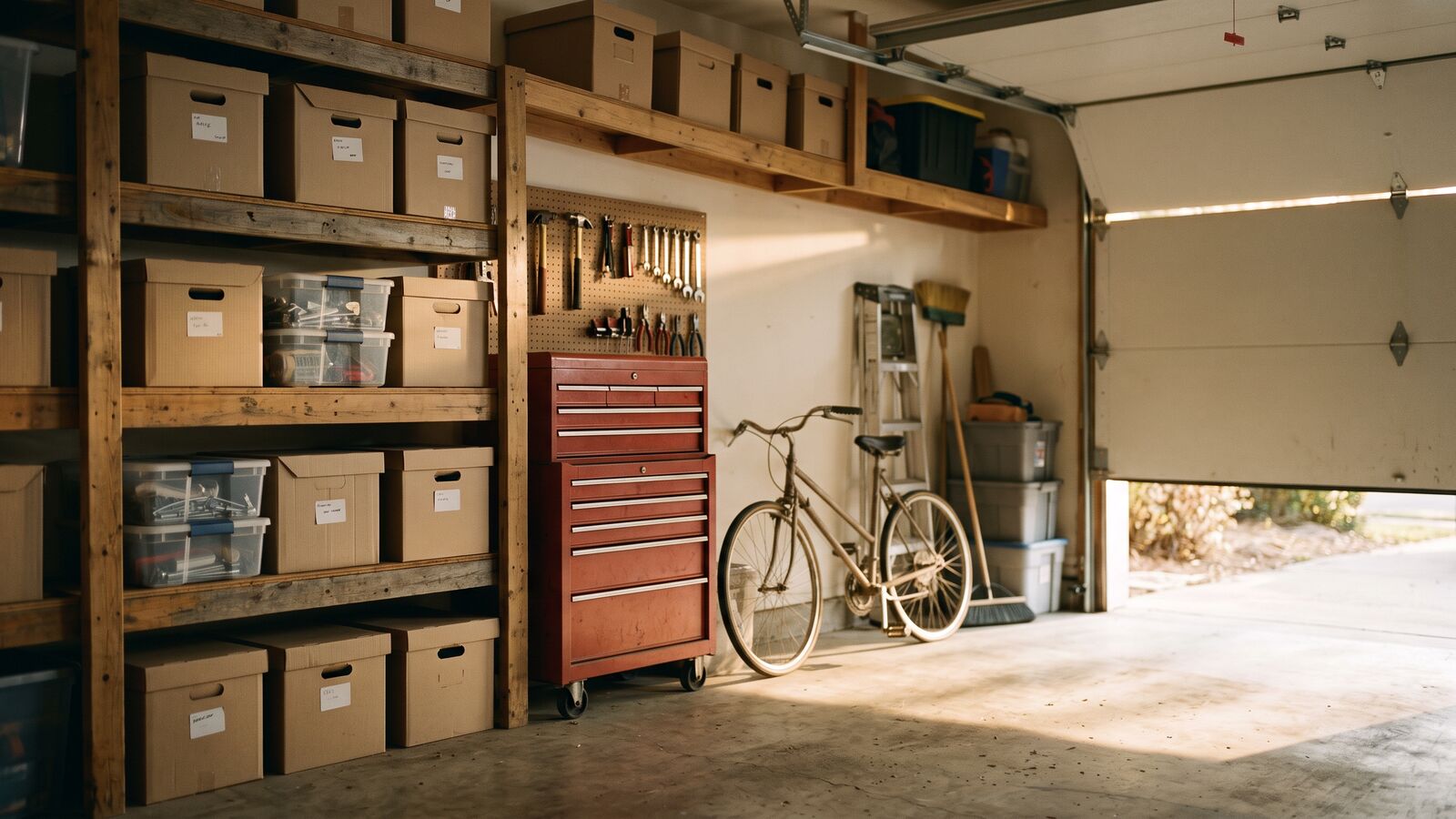
You need the tile cutter you bought for one job two years ago. You know it is in the garage. You lift four boxes, open two bins, find the Christmas lights twice, and give up. Twenty minutes later you order a new one.
Garages, lofts, basements and storage closets all fail the same way. Things go in on a busy day, in whatever box is nearest, and nobody writes anything down. The space is full of things you own and cannot use.
Split the space into zones first
Before you buy a single shelf, decide what each part of the garage is for. Four or five zones cover most homes:
- Tools and DIY: hand tools, power tools, screws, paint.
- Seasonal: decorations, camping gear, winter or summer kit.
- Car and bike: cleaning kit, pumps, chains, spare bulbs.
- Household overflow: bulk paper towels, spare bedding, the second kettle.
- Keep for now: kids' clothes for later, things you are selling, sentimental boxes.
Zones matter more than containers. A garage with clear zones and mismatched boxes works. A garage with matching bins and no zones does not.
Give every shelf and bin a number
Descriptions drift. "Camping stuff" slowly fills with extension cords and a broken lamp. A number does not drift, because it only says where the bin is, not what it should contain.
- Number each shelving unit: 1, 2, 3.
- Number the shelves on it from the top: 1.1, 1.2, 1.3.
- Number the bins and boxes on each shelf, or just give every container its own number.
Write the number large on the front of each box, where you can read it from the middle of the garage. Opaque boxes need it most. Clear bins help, but you still cannot see what is at the bottom.
A number on the box and a list of what is in it beats any amount of labelled tape that says "misc".
Write down what goes where, once
The list is the part people skip, and it is the part that saves you. It does not need to be perfect. For each box, note its number and the things you would ever look for: "Box 7: tile cutter, grout float, spare tiles from the bathroom."
Keep the list on your phone, not on a sheet pinned to the garage wall. You will want it when you are at the hardware store wondering whether you already own a stud finder.
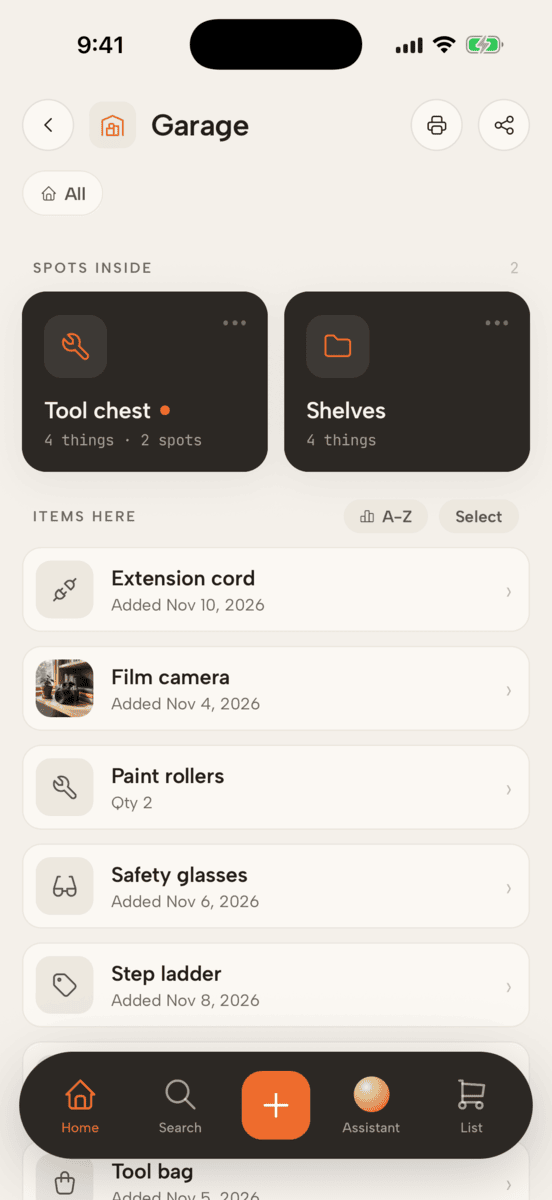
Photograph the shelves, not every object
Nobody will catalogue a garage item by item. You do not have to. A photo of each shelf and a photo of the inside of each box, taken as you pack it, does most of the work. When you search later, the photo shows you what the box looked like, which is often how you recognise it.
Lofts, basements and closets
The same method works anywhere things go to be forgotten. In a loft or attic, put the most-used boxes nearest the hatch and the list on your phone, because you will be reading it on a ladder. In a basement, keep boxes off the floor in case of damp. In a hall closet, a single shelf with three numbered bins is enough.
Keep it working
- New thing in, update the list. Ten seconds when you put it away saves twenty minutes when you need it.
- Lending tools? Note who has the ladder. The garage is where borrowed things quietly never come back.
- Twice a year, walk the zones and move what has drifted.
Set up the garage from one photo
Photograph a wall of shelves and Remio lists the storage it sees, counts the drawers and suggests the room’s name. Add what goes in each box, print contents labels with a QR code, and search for anything later. Free to start, nine languages.
Get Remio on the App Store