Guide
How to make a home inventory for insurance

After a burglary or a burst pipe, the insurer asks for a list of what was damaged or taken, with values. Most people sit down and try to remember. They forget the camera bag, the second laptop charger, the coats in the hall, and the tools in the shed. What is not on the list usually does not get paid.
A home inventory is that list, made calmly in advance. It does not have to be complete to be useful. It has to exist.
Requirements differ by insurer, policy and country. Check what yours asks for; this guide covers what is commonly useful.
What to record for each item
- What it is, with make and model for anything electronic.
- Which room it is in. Claims are often settled room by room.
- A photo. One clear picture proves you owned it and shows its condition.
- What you paid and when. An estimate is fine for older things; a receipt is better for expensive ones.
- Serial number for electronics, bikes and tools. It also helps the police if something is stolen.
Go room by room
Start at the front door and work through the house in one direction, so you do not skip a room. In each room, photograph each wall, then open the cupboards and photograph those too. Then list the things that matter.
Do the expensive things first. If you only finish one room, make it the one with the laptop, the camera and the bikes.
Do not forget the places you rarely go: the shed, the loft, the garage, the storage unit. They hold more value than people think, and they are where things are least likely to be remembered.
Keep the receipts with the items
For anything expensive, photograph the receipt and keep it with the item's record. Thermal receipts fade within months, so do it the day you buy, not the day you need it. The same record covers the warranty, so it pays off twice.
Store a copy away from home
An inventory kept only in the house can burn with the house. Export it, as a spreadsheet or a PDF with photos, and keep that copy somewhere else: your email, a cloud drive, a family member. Update it once a year and after any big purchase.
A one-hour version
- Walk through every room and photograph each wall and open cupboard.
- List the ten most valuable things in the house, with photos and rough values.
- Photograph any receipts you still have for them.
- Export the list and send it somewhere outside the house.
That hour will not cover everything, but it covers what usually goes missing from a claim.
A home inventory that stays current
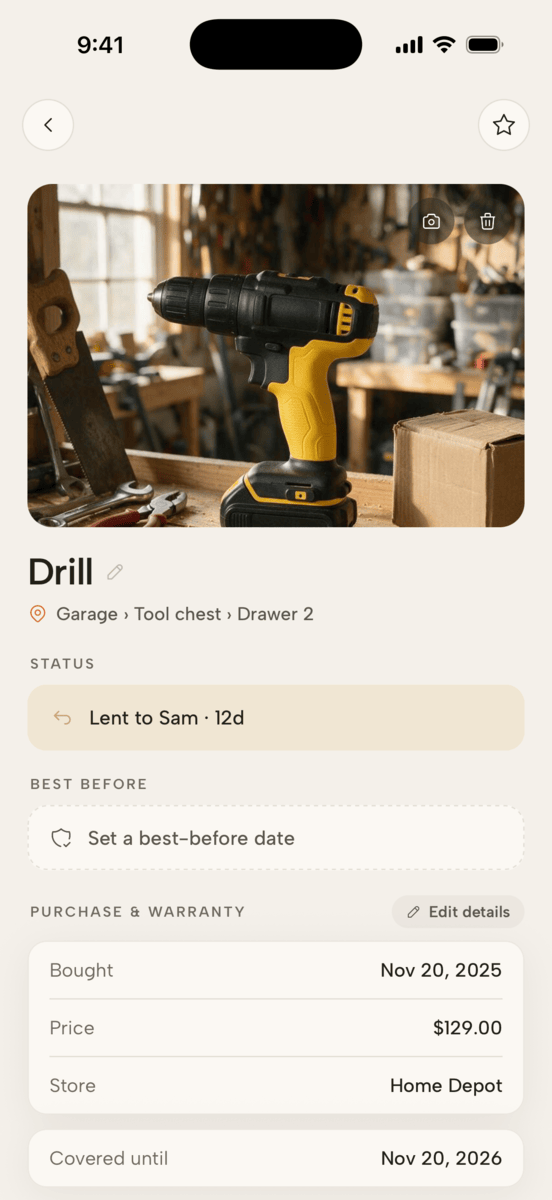
Remio keeps each item with photos, the room it is in, what you paid, where you bought it, the receipt and the warranty date. Export the whole house to Excel or a PDF with photos and keep a copy wherever you like. Free to start, nine languages.
Get Remio on the App Store