Comparison
A Sortly alternative for keeping track of things at home
We make Remio, one of the apps compared here. The facts about Sortly and the other apps come from their own App Store pages, websites and help centres, checked on 16 November 2026, and the sources are listed at the end.
The short answer
Keep Sortly if you run a business, a workshop or a stockroom, need barcode labels and stock levels, or share one inventory with a team on Android and the web. For a home, Sortly is more tool than most people need, and its paid plans are priced for businesses. If what you want is to find things in your own house, a home inventory app does that with less setup and no account.
Why people look for an alternative
- It is built for business. Sortly's App Store subtitle is "Inventory Tracker for Business", and its website talks about supplies, parts, tools and equipment for construction, medical, warehouse and retail teams.
- The paid plans are business prices. The free plan covers 100 items and one user. The first paid plan, Advanced, is listed at $49 a month and shown at $24 a month billed yearly ($288) for a customer's first year. The 14-day trial on paid plans asks for a card.
- It works with a cloud account. Your inventory syncs across devices and users through Sortly's servers. That is useful for a team and less necessary for one household.
- The fields are about stock. Quantities, minimum levels, folders and custom fields suit a stockroom. At home the question is usually simpler: where did I put it?
Sortly and Remio side by side
| Sortly | Remio | |
|---|---|---|
| Built for | Business inventory: supplies, parts, tools, equipment | Finding things at home |
| Free | 100 items, 1 user | 50 things, 5 AI scans a month, 5 moving boxes; everything unlocked for the first 7 days |
| Paid | Advanced from $24 a month billed yearly in the first year, then higher tiers | $3.99 a month, $24.99 a year or $79.99 once (US App Store) |
| Account | Cloud account, synced across devices and users | Not needed; the inventory stays on the phone |
| Adding an item | Photos, fields, barcode or QR scan | Photo, the AI suggests a name, you pick the place |
| Barcodes and QR | Scans barcodes and QR codes, prints labels | No barcode scan; prints QR contents labels for boxes and shelves |
| Export | CSV, XLSX, PDF report with photos | PDF list, Excel file, QR contents labels |
| Reminders | Low stock and date alerts | Warranties, lent things, low stock, food about to expire |
| Moving | Not a feature on its store page | Moving mode with numbered boxes and a list to share with helpers |
| Team use | Several users with access levels | One phone; no shared editing |
| Platforms | iPhone, iPad, Android, web | iPhone |
Where Remio is different
Remio starts from the everyday question rather than the stock count. You photograph a thing, the AI suggests a name, and you say where it lives: the garage shelf, box 7, the hall drawer, or the neighbour who borrowed it. Later you search, or ask the built-in assistant "where is the drill?", and it takes you to the spot. The assistant works offline.
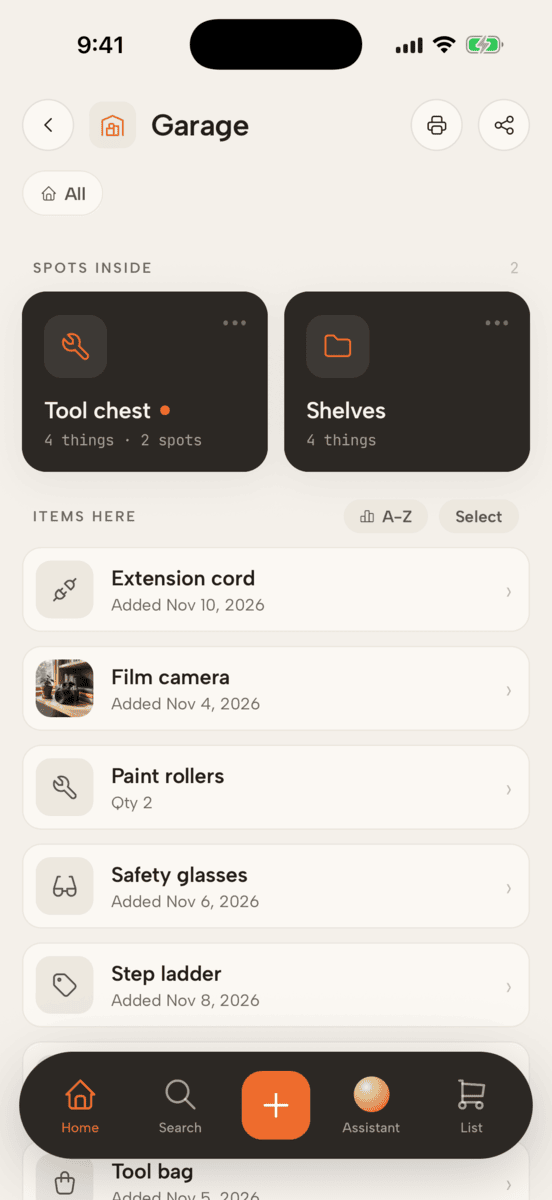
There is no account to create and no server holding your list. The one online step is "Identify with AI", which sends a single photo to suggest a name; the photo is not stored. When you want the list somewhere else, any spot, from one box to the whole house, exports as a printed list, an Excel file or a sheet of QR labels that open the contents in any phone's browser.
Remio also covers the parts of home life a stock tool does not: reminders before a warranty ends, a record of who has your things, and a moving mode for numbered boxes.
Where Sortly is still the better choice
- You track stock for a business, or for a side business run from home.
- You need barcode scanning, barcode labels or minimum stock levels.
- Several people edit the same inventory, or someone uses Android or a computer.
- You need detailed and saved custom reports.
Remio does none of the first three, and it is new, with few App Store ratings so far. Sortly has been on the App Store for years and has thousands of ratings.
Other home alternatives to Sortly
- Under My Roof is a thorough home inventory for iPhone, iPad and Mac, with barcode scanning, insurance coverage analysis, estate planning, CSV import and export, and optional sync through your own iCloud. Free for 10 items, then $4.99 a month or $34.99 a year.
- Itemtopia is a home inventory with apps for iPhone, iPad and Android plus a web version, family invites, warranty reminders and barcode labels. Premium is $7.99 a month or $79.99 a year.
We compare these and four more on one page: the best home inventory apps for iPhone.
Moving your inventory out of Sortly
Sortly's help centre describes exporting an inventory summary as CSV or XLSX, and a PDF report with photos. Keep that file either way: it is your record of what you had.
Under My Roof can import CSV. Remio only restores its own backups and cannot read a Sortly file, so in Remio you add things again by photo. Each entry takes a few seconds. A practical order is one place at a time: start with the shelf or box you open most, then the rest of that room. Our guide to setting up a home inventory in an afternoon walks through it.
Try Remio with your own things
Everything is unlocked for the first 7 days, and the free version keeps up to 50 things after that. No account: photograph the first thing you keep losing and tell Remio where it lives.
Get Remio on the App StoreQuestions people ask
Is Sortly good for home inventory?
What is a good Sortly alternative for home use?
Can I move my Sortly inventory to another app?
Sources
Checked on 16 November 2026. Prices are from the US App Store and the developers' own pricing pages.
- Sortly: App Store, sortly.com/pricing, sortly.com, help centre: reports
- Remio: App Store
- Under My Roof: App Store
- Itemtopia: App Store
Something out of date? Write to [email protected] and we will correct it.